An 8-day West Coast Trail plan changes the gear problem. The route is 75 km, so the load has to carry more food while still protecting belongings in coastal conditions.
8-Day West Coast Trail Buying Assumptions
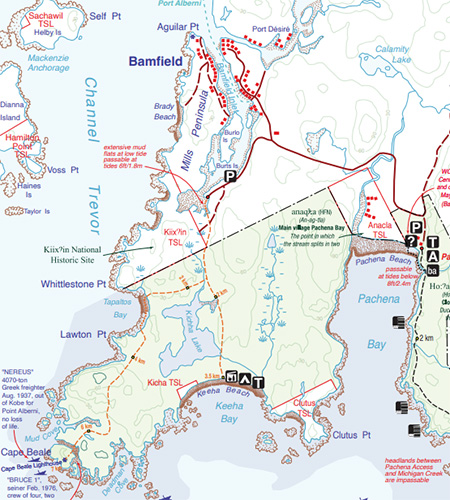
The West Coast Trail is a 75 km coastal backpacking route in Pacific Rim National Park Reserve. Parks Canada says most hikers spend 6 to 8 days on the full route. An 8-day plan averages about 9.4 km per day before campsite setup, tide timing, beach detours, ladder sections, cable cars, and rest stops. That reduces daily distance pressure compared with faster itineraries, but it increases food volume and makes pack organization more important.
August weather context: Environment Canada daily data from Cape Beale Light, near the northern West Coast Trail and Bamfield side, show that August 2020-2025 averaged 18.3°C daily highs, 12.4°C daily lows, and 80.1 mm of monthly precipitation. Fog is common, especially in July and August. Those values and coastal visibility conditions support compact rain protection, dry storage, and a sleeping pad with damp-camp margin rather than a minimal summer-only sleep system.
The list below is built around a 65 L backpack. Choose the backpack to fit 8 days of all gear, clothes, and meals inside the pack rather than relying on loose external storage. As a planning estimate, meals commonly add about 0.7-0.9 kg per person per day, or about 5.6-7.2 kg per person for 8 days before shared extras such as fuel, rope, and group food packaging. Any item with official dimensions is translated into approximate pack volume and shown as a percentage of 65 L. These calculations are planning estimates from listed dimensions, not manufacturer-stated packed volumes unless the manufacturer or retailer provides a volume directly.
Buying Priorities for This Route
For an 8-day West Coast Trail trip, the pack system should protect insulation, keep wet gear away from dry gear, and leave enough internal space for a larger food load and mandatory safety items. Treat every critical item as if it needs waterproof protection: sleeping bag, under-layers, food, electronics, first aid, and maps.
Lightest choices: MSR FreeLite 2 is the lightest tent in the comparison, Big Agnes Rapide SL is the lightest listed insulated pad choice, Jetboil Zip is the lightest listed stove system, and Black Diamond Distance FLZ is the trekking pole choice.
Most packable sleep system: Marmot Never Winter plus Big Agnes Rapide SL uses about 6.9 L of measured or listed pack volume before clothing and dry-bag compression. That leaves more than 89% of a 65 L pack for tent, food, clothing, water treatment, trekking poles, rain cover, poncho, sandals, socks, and safety gear.
Warmest listed sleeping pad: Big Agnes Rapide SL has an R-value of 4.8 among the selected compact pads. The Sea To Summit Ether Light XR is R 4.1 and wider, but heavier and bulkier. Cape Beale Light averaged 12.4°C August lows from 2020-2025, so these pads are warmer than a minimum summer pad but provide margin for damp coastal camps.
Campsites, Tent Surfaces, and Food Storage
Parks Canada does not describe standardized tent pads for West Coast Trail camping areas on the main route page. Instead, its low-impact guidance says to camp on the beach above the high-tide line where possible to reduce soil compaction in vegetated areas. That means the tent should be chosen for sand, damp ground, and careful high-tide placement rather than for a fixed wooden pad.
For food storage, Parks Canada gives three options in order of availability: use metal food lockers, use bear poles, or hang food, garbage, and toiletries out of reach of animals and away from tents. If food lockers are full or absent, Parks Canada says to hang food approximately 4 m off the ground and 3 m away from the tree trunk. Carry 15 metres (50 ft) of synthetic rope per group to hang food and to use as a clothesline. The page also says not to leave extra food or supplies in lockers when leaving camp.
Protect Sleep Gear
Pack sleeping bags in waterproof bags and keep sleep clothing separate from rainwear.
Keep Tent Practical
Use a tent with a waterproof fly, vestibule space, condensation control, and reliable setup.
Control Food Volume
An 8-day meal load is about 5.6-7.2 kg per person and requires waterproof organization.
Carry Backup Communication
A satellite link or GPS device adds emergency margin and should be kept in waterproof storage.
Comparison Table: Core Gear for an 8-Day West Coast Trail Pack
| Role | Product | Weight | Capacity or Volume | Overall |
|---|---|---|---|---|
| Backpack | ULA Circuit Backpack | 1.13 kg (2.49 lb) | 68 L | The 68 L capacity leaves room for 8 days of gear, clothes, and meals, plus rainwear, dry bags, trekking poles, and a compact tent. Meal weight is approximately 5.6-7.2 kg per person for 8 days before shared extras. The pack must fit well and have a padded hip belt so weight transfers to the hips. The listed recommended load is 16 kg, so an 8-day route should keep food, water, and shared gear weight controlled. |
| Backpack rain protection | Rain cover for the backpack | Depends on pack size and model | Select a cover sized for a 58-68 L pack | A rain cover reduces direct rain exposure on the pack fabric. It does not replace lining the pack with a heavy-duty garbage bag or waterproof liner, because water can still enter through the back panel, shoulder straps, seams, or during pack handling. |
| More available pack option | Osprey Eja 58 Backpack | 1.23-1.28 kg (2.71-2.82 lb) | 58 L | The smaller capacity works only if 8 days of gear, clothes, and meals fit inside the pack with a compact tent, sleeping bag, pad, and dry-bag system. It gives less margin for bulky rain layers, wet camp clothing, and about 5.6-7.2 kg of meals per person. |
| Tent | MSR Hubba Hubba LT 2-Person Tent | 1.54 kg packed; 1.36 kg minimum (3.40 / 3.00 lb) | 51 x 14 cm; about 7.8 L, or 12.1% of a 65 L pack | Freestanding structure is more forgiving on tent pads, uneven wooden surfaces, and hard-packed campsites. A waterproof fly is required for wet conditions. Two vestibules separate wet gear from the sleeping area and help condensation management. |
| Sleeping bag | Marmot Never Winter Sleeping Bag | 830 g (1.83 lb) | 5.3 L, or 8.2% of a 65 L pack | The 3.1 C comfort rating is moderate. It is lighter than the Greystone while occupying nearly the same pack volume. Pack the sleeping bag in a waterproof bag before placing it inside the lined backpack. |
| Sleeping pad | Big Agnes Rapide SL Insulated Sleep Pad | 510 g regular (1.12 lb) | 20 x 10 cm; about 1.6 L, or 2.4% of a 65 L pack | The R-value is 4.8. That is warmer than a summer foam pad and gives more margin for damp coastal camps without taking much pack volume. |
| Water treatment | Platypus QuickDraw Filter | 69 g (2.43 oz) | Dimensions not specified by the retailer | The 0.2 micron hollow-fibre filter is listed as effective against bacteria and protozoa, but not viruses. The low weight suits an 8-day pack because water treatment should not consume much pack volume. |
| Stove | Jetboil Zip 0.8L Fast Boil System | 324 g (11.43 oz) | 10.4 x 10.4 x 16.5 cm; about 1.8 L, or 2.7% of a 65 L pack | Lightest stove system listed. It boils water quickly, but it does not simmer and has no piezo ignition, so carry a lighter. |
| Dry storage | Sea To Summit Evac Compression Dry Bag | 136 g for 13 L (4.80 oz) | 13 L, or 20.0% of a 65 L pack before compression | Use it for the sleeping bag or insulating layers. The listed compression ratio is up to 33%, which helps keep the sleep system inside the pack while protecting it from wet conditions. |
| Budget dry bag | MEC Pack Rat Roll Top Silicone Dry Sack | 50 g for 10 L (1.76 oz) | 10 L, or 15.4% of a 65 L pack | Lowest listed price range in this dry-bag group. It is water-resistant, not listed as waterproof, so it is better for spare clothing than for primary sleep-system protection. |
| Group rope | 15 m (50 ft) synthetic rope | Depends on rope diameter and material | Small group item; store dry and accessible | Carry one per group for food hanging when lockers or bear poles are unavailable and for use as a clothesline. Do not count it as a substitute for proper waterproof storage. |
| Trekking poles | Black Diamond Distance FLZ Poles | 251 g (8.85 oz) | 40 cm packed length (15.7 in) | Adjustability matters on uneven beach exits, ladders, and forest sections. Carbon models are lighter, but aluminum is less brittle under side loading. |
| Rain layer | Poncho | Depends on model | Not specified until a product is selected | A poncho is useful on the West Coast Trail because it can cover the hiker and part of the pack during rain. Choose a real backpacking poncho with enough length for pack coverage and secure side closure in wind. |
| Water crossing and camp footwear | Sandals | Depends on model | Not specified until a product is selected | Carry sandals for stream crossings and camp use. They should stay secure on wet ground, drain quickly, and be comfortable enough for camp chores after hiking shoes are wet. |
| Hygiene | Toilet paper, waste bags, and garbage bags | Depends on quantity | Small item; keep waterproof | Carry toilet paper in waterproof storage, bring small waste bags for used toilet paper, and bring garbage bags to pack out all your garbage. Parks Canada says outhouses are available at designated camping areas, and toilet paper should be disposed of in outhouses or packed out. |
| Socks | 9 pairs merino wool socks | Depends on model and cushion weight | Small clothing volume; keep sleep pair dry | Pack one hiking pair for each day and one dry pair reserved for sleep. Merino wool is useful because it remains comfortable when damp and reduces the need to hike in the same wet pair repeatedly. |
| Emergency communication | Motorola Defy Satellite Link | 70 g (2.47 oz) | 11.2 x 6.2 cm (4.4 x 2.4 in) | Lower carried weight than a handheld GPS. It is not a map device, so use it as communication backup, not navigation replacement. Keep electronics in waterproof storage. |
| Cash | Canadian cash for water taxi and limited food purchases | Not applicable | Small item; keep waterproof | Carry cash in waterproof storage. Parks Canada says the Balaats’adt (Nitinaht Village) Water Taxi fee can be paid in cash directly to the operator, and access-point services may include some groceries and food services. Do not rely on trail food availability. |
| Wildlife safety | Bear spray | Depends on canister size | Carry externally accessible; not packed deep inside the backpack | Parks Canada strongly recommends that at least one person per group carry bear spray and know how to use it. Choose a legal, current canister and confirm transport rules before travel. |
West Coast Trail context: Parks Canada describes the West Coast Trail as a 75 km route through old-growth forest, beaches, rivers, streams, and suspension bridges. Hikers climb more than 100 ladder systems with a heavy pack, trudge through deep mud, wade through fast-flowing rivers, and endure rough West Coast weather, often heavy wind and rain. Gear choices should assume that everything important needs waterproof protection.
Recommended 8-Day Packing List
Carry System
ULA Circuit Backpack is the strongest carry choice here because 68 L gives room for 8 days of gear, clothes, meals, rain layers, dry bags, and a compact tent while staying close to 1.13 kg. For meal planning, estimate about 0.7-0.9 kg per person per day, or about 5.6-7.2 kg per person for 8 days before shared extras. Backpacks require a well fitted, padded hip belt so the load is carried primarily through the hips rather than the shoulders. The pack should also be lined with a heavy-duty garbage bag or waterproof liner before dry bags are added. The recommended load is listed as 16 kg, so the rest of the kit should stay compact. The Osprey Eja 58 Backpack is a smaller-capacity alternative only when all gear, clothing, and meals fit inside the pack.
Tent and Condensation
Sleep System
Marmot Never Winter Sleeping Bag is the preferred sleeping bag in this draft because it weighs 830 g, has a 3.1 C comfort rating, and packs to 5.3 L. The Big Agnes Greystone 30 Down Sleeping Bag has a similar 4 C comfort rating and 5.1 L packed volume but weighs 907 g.
Big Agnes Rapide SL Insulated Sleep Pad is the pad choice because R 4.8 gives more insulation margin than a thin foam pad while taking about 1.6 L in a 65 L pack. Cape Beale Light averaged 12.4°C August lows from 2020-2025, so the extra insulation is mainly damp-ground margin rather than a cold-weather requirement. The Sea To Summit Ether Light XR Insulated Rectangular Sleeping Mat is wider and rectangular but heavier.
Water, Cooking, and Food Storage
Platypus QuickDraw Filter weighs 69 g and is listed as effective against bacteria and protozoa. The Hydrapak Seeker+ 3L Filter Kit weighs more at 127 g but adds a 3 L reservoir format, which can be useful if dry camp timing is a concern.
Jetboil Zip 0.8L Fast Boil System is the lightest stove system listed at 324 g. It is suitable for boil-only meals and hot drinks. The Jetboil Flash 1.0L Fast Boil System adds ignition and windscreen features but weighs 371 g.
Sea To Summit Evac Compression Dry Bag should carry the sleeping bag or spare insulation. Pack sleeping bags in waterproof bags before loading them into the backpack. Add smaller waterproof bags for electronics, first aid, tide charts, maps, and sleep clothing. Carry 15 metres (50 ft) of synthetic rope per group for food hanging and as a clothesline. The MEC Pack Rat Roll Top Silicone Dry Sack is the budget option in this set, but it is listed as water-resistant rather than waterproof, so it should not be the only protection for down insulation.
Movement and Safety
Black Diamond Distance FLZ Poles are the pole choice because they adjust from 100-140 cm and pack to 40 cm. Adjustable poles are more useful than fixed poles when terrain changes between forest, ladders, beach approaches, and camp travel.
The Motorola Defy Satellite Link is a low-weight communication backup at 70 g. The Garmin GPSMAP 65 is heavier at 217 g but adds mapping and navigation functions. Neither replaces Parks Canada orientation, tide planning, tide charts, or carrying the required route information.
Carry tide charts with the West Coast Trail map. Parks Canada says to use tide tables and the map to avoid being trapped or cut off by impassable headlands. Keep printed tide charts in waterproof storage and check them before beach travel or beach camping.
Carry Canadian cash in waterproof storage. Parks Canada says the Balaats’adt (Nitinaht Village) Water Taxi fee can be paid in cash directly to the operator, and access-point services may include some groceries and food services. Use cash as a backup for the water taxi and limited purchases where available, not as a substitute for carrying enough meals for the full route.
Add bear spray for group wildlife safety. Parks Canada strongly recommends that a minimum of one person per group carry bear spray and know how to use it. It should be accessible while hiking rather than packed deep inside the backpack, and travellers should confirm legal transport rules before carrying it by ferry, bus, or aircraft.
Do not bring pets. Parks Canada says dogs are not permitted on the West Coast Trail unless they are service animals.
Rainwear, Under-Layers, Stream Crossings, and Socks
Add a backpack rain cover, poncho, under-layers that keep you warm, stream-crossing sandals, toilet paper, waste bags for used toilet paper, garbage bags, and nine pairs of merino wool socks to the core list. The rain cover should fit the loaded pack size, but it should not replace internal dry bags. The poncho should cover both the hiker and part of the pack. Under-layers should stay warm when damp and should be kept in waterproof storage until needed. Sandals should be secure enough for stream crossings and comfortable enough to use as camp shoes. Keep toilet paper waterproof and dispose of it in outhouses or pack it out. Bring small waste bags for used toilet paper and garbage bags to pack out all your garbage, including food packaging and used hygiene items. For socks, pack one merino wool hiking pair per day and one separate dry pair for sleeping.
Buying Advice
For an 8-day West Coast Trail pack, the largest volume decisions are food, tent, sleeping bag, and dry-bag system. Plan meals at about 5.6-7.2 kg per person for the full 8 days, then add packaging, fuel, and any shared food items. A compact 2-person tent around 4-8 L, a sleeping bag around 5-6 L, and a sleeping pad under 2 L leave more internal room for food, trekking poles, rain cover, poncho, sandals, socks, and rain protection. If the tent or sleeping bag becomes bulky, a 58 L pack becomes difficult to load cleanly.
Do not choose the lightest item in every category automatically. The lightest tent saves weight but requires more careful setup. The lightest dry sack may not be waterproof enough for down insulation. The lightest communication device may not provide maps. For this route, waterproof protection is not optional for insulation, clothing, electronics, food, and documents. The better choice is the item that removes the most route-specific risk for the least weight and volume.
Related TrailReady Guides
Use this packing list with these related TrailReady guides before finalizing the kit.
- 2-Person Backpacking Tent Comparison
- Backpacking in Continuous Rain
- Water Filter Storage and Maintenance
- 50L-65L Backpacks for a 3-Day Trip
FAQ
Can the West Coast Trail be planned as an 8-day backpacking trip?
Yes. Parks Canada says most hikers spend 6 to 8 days on the full route. An 8-day plan averages about 9.4 km per day before delays from tide timing, beach travel, ladders, cable cars, and camp setup. The gear list should therefore leave more room for food while still avoiding loosely strapped external items.
What backpack size works for this list?
A 65 L to 68 L pack is the practical planning range if the tent and sleep system remain compact. Choose the backpack to fit 8 days of all gear, clothes, and meals inside the pack. Meals will weigh approximately 0.7-0.9 kg per person per day, or about 5.6-7.2 kg per person for 8 days before shared extras. A 58 L pack has less margin for eight days of food, rainwear, dry bags, trekking poles, and safety items.
What historical August weather did you use?
We used Environment Canada daily data from Cape Beale Light for August 2020-2025. The six August seasons averaged 18.3°C daily highs, 12.4°C daily lows, 80.1 mm of monthly precipitation, and 13.7 days per August with at least 0.2 mm of precipitation.
Do West Coast Trail campsites have tent pads?
Parks Canada does not describe standardized tent pads for West Coast Trail camping areas on the main route page. It advises campers to camp on the beach above the high-tide line where possible to reduce soil compaction in vegetated areas.
What are the food storage options?
Use metal food lockers or bear poles when they are available. If lockers are full or no food-storage structure is available, hang food, garbage, and toiletries out of reach of animals and away from tents. Parks Canada specifies about 4 m off the ground and 3 m away from the tree trunk. Carry 15 metres (50 ft) of synthetic rope per group to hang food and to use as a clothesline.
Do I need tide charts?
Yes. Parks Canada tells hikers to use tide tables and the West Coast Trail map to avoid being trapped or cut off by impassable headlands. Carry tide charts in waterproof storage and check them before beach travel or beach camping.
Should I pack toilet paper, waste bags, and garbage bags?
Yes. Carry toilet paper in waterproof storage, bring small waste bags for used toilet paper, and bring garbage bags to pack out all your garbage. Parks Canada says outhouses are available at designated camping areas, and toilet paper should be disposed of in outhouses or packed out.
Can I bring pets?
No. Do not bring pets. Parks Canada says dogs are not permitted on the West Coast Trail unless they are service animals.
Should I carry cash?
Yes. Carry Canadian cash in waterproof storage. Parks Canada says the Balaats’adt (Nitinaht Village) Water Taxi fee can be paid in cash directly to the operator, and access-point services may include some groceries and food services. Do not rely on buying food on the trail; carry enough meals for the full route.
Should I choose the lightest tent?
Not automatically. MSR FreeLite 2 is lighter, but a freestanding tent such as MSR Hubba Hubba LT is more forgiving on tent pads, uneven wooden surfaces, and hard-packed campsites. The lighter tent also requires more careful ventilation and setup to manage condensation.
Do I need dry bags in August?
Yes. The route is coastal and includes forest and beach travel. Dry bags are the simplest way to keep the sleeping bag, spare clothing, and electronics separated from rainwear, wet tent fabric, and damp pack contents. Everything important should have waterproof protection, especially insulation, food, electronics, first aid, maps, and sleep clothing.
How TrailReady Helps
We use destination, trip length, group size, expected conditions, pack capacity, and gear specifications to build a practical backpacking list. For the West Coast Trail, that means balancing weight against rain protection, dry storage, tent condensation control, and emergency margin.
Use TrailReady to plan your next backpacking trip and build a gear list based on your route, season, trip length, and expected conditions.
References
- Parks Canada. Pacific Rim National Park Reserve activities and West Coast Trail overview.
- Parks Canada. West Coast Trail hiker preparation guide.
- Environment and Climate Change Canada. Daily climate data for Cape Beale Light.
- ULA Equipment. Circuit Backpack specifications.
- MEC. MSR Hubba Hubba LT 2-Person Tent specifications.
- MEC. MSR FreeLite 2-Person Tent specifications.
- Plein Air Entrepot. Marmot Never Winter sleeping bag specifications.
- Big Agnes Canada. Greystone 30 Down sleeping bag specifications.
- Big Agnes Rapide SL Insulated Sleep Pad retail listing.
- MEC. Platypus QuickDraw Filter specifications.
- MEC. Jetboil Zip 0.8L Fast Boil System specifications.
- MEC. Sea To Summit Evac Compression Dry Bag specifications.
Plan your next backpacking trip with TrailReady.